Home / All / Industry Insights / Selecting Bathroom Products: How to Balance Design, Durability, and Cost
Selecting Bathroom Products: How to Balance Design, Durability, and Cost
Oct 19,2026
Every bathroom specification is a fixed budget spent across three demands that pull against each other: how it looks, how long it lasts, and what it costs. Trying to maximise all three at once is how projects end up with a shower that photographs beautifully and drips in year three. The workable approach is to fix the order of decisions — installation form first, then material and finish, then design — because that is the sequence in which cost becomes irreversible.
This guide is written for distributors, contractors and facility buyers specifying taps and shower sets in African markets, where labour is often cheaper than the part but rework is expensive, and where spare-part availability decides whether a repair takes a day or a quarter. It covers where the money actually goes, which savings are safe, and how to match a specification to the building rather than to a catalogue page.
Framework
The Trade-off Is a Triangle, Not a Checklist
Design, durability and cost are usually presented as three separate boxes to tick. They are not independent. In any fixed budget, adding to one takes from the others, and the only real decision is which of the three you are willing to under-serve for this particular building.
The practical rule is to spend first on what is expensive to change later, and economise on what can be swapped without opening a wall. A concealed valve body buried behind tiles is a fifteen-year decision made in one afternoon. A hand shower, a hose or a decorative cover plate can be replaced in twenty minutes and should never be the line item that consumes the budget.
Budget tier
What you can reasonably expect
What usually gets traded away
Entry
Reliable function, consistent finish, serviceable parts, a limited choice of shapes
Surface sophistication, very large heads, concealed installation, custom colours
Mid
Better body materials, more durable coating, both exposed and concealed options, wider geometry choice
Full finish range, concealed and exposed in the same design language, premium surface treatment, long spare-part support
Little — but the discipline of not over-specifying where the building does not need it
Tiers describe what a specification can realistically include, not what any single product offers. A cheap product in the upper tier does not exist, and neither does a premium product at entry price.
Design
Design Decisions That Cost Nothing, and the Ones That Cost Everything
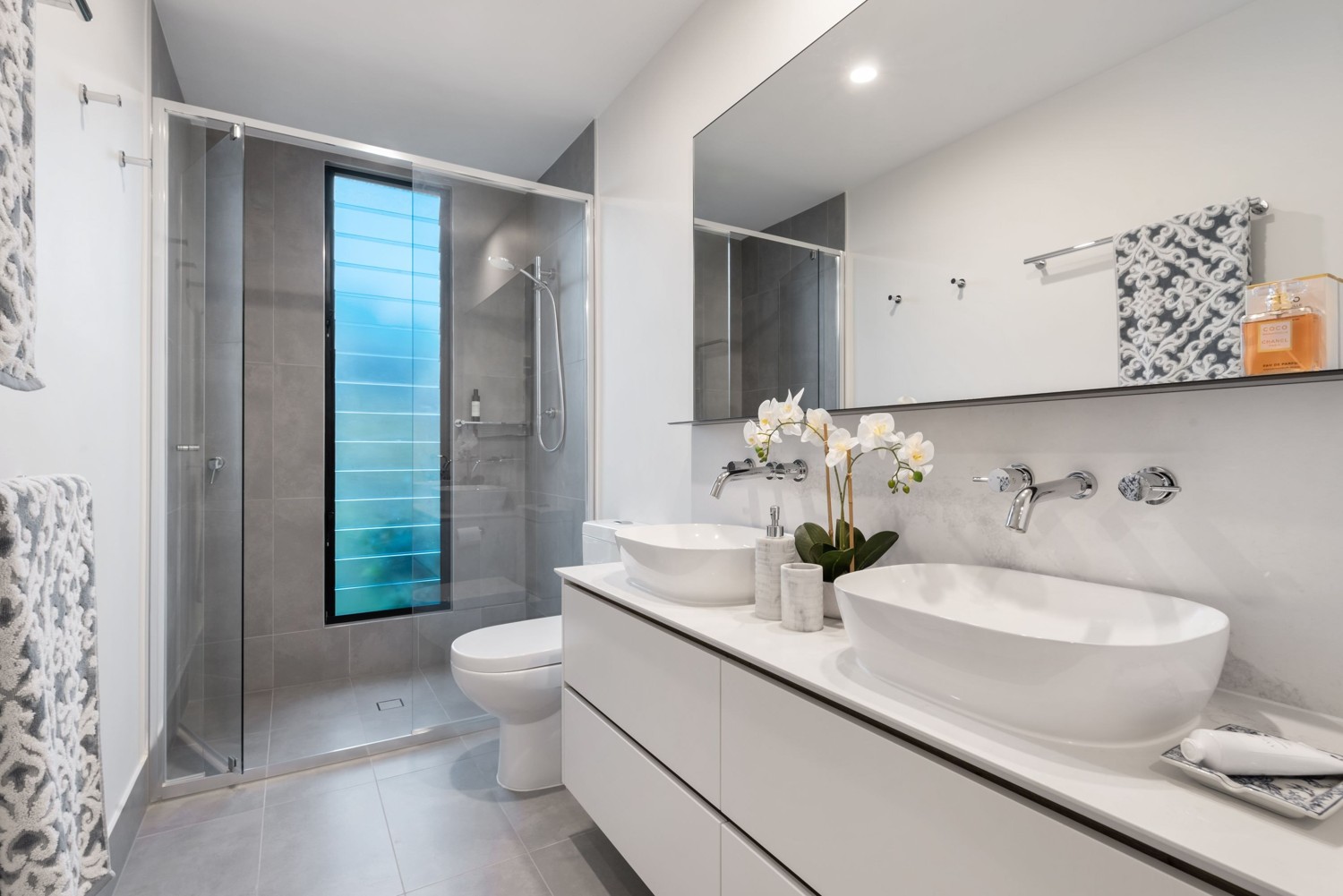
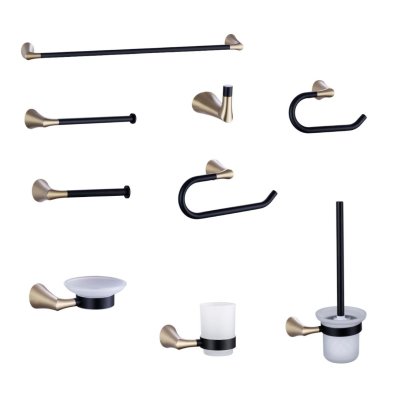
Most of what makes a bathroom read as considered is free. Proportion is free: a rain head sized to the shower footprint rather than to the ceiling looks correct, and one oversized head in a small cubicle looks wrong no matter what it cost. Consistency is free: keeping the metal finish to one family across taps, shower and accessories does more for the room than any single upgraded item. Restraint is free: two metal colours in one bathroom is a decision, three is an accident.
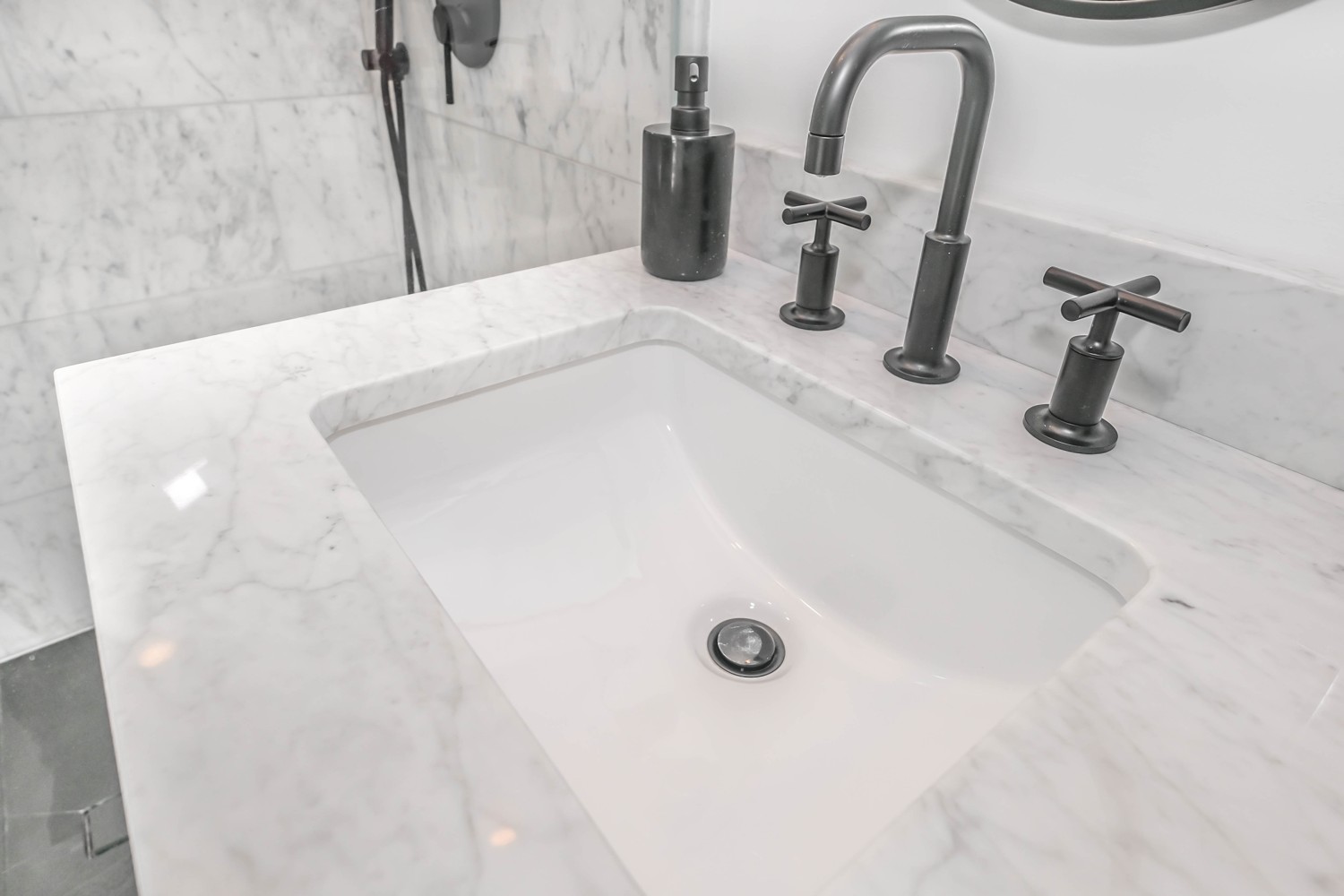
What is genuinely expensive is anything that changes the building. Concealed installation requires a valve body set into the wall before tiling, a service access point, and the acceptance that a future repair means opening the wall rather than unscrewing a fitting. It buys a cleaner wall and a more architectural result, and it is worth it in villas, hotels and any project where the bathroom is part of the sale. It is a poor trade in a retrofit where the wall is already finished and the pipe centres are unknown.
Concealed installation: the cleanest wall line in the category, and the least reversible decision in the specification.
The other expensive category is anything non-standard: unusual widths, colour-matched finishes, custom spout lengths. Each one turns a stock item into a project item, adds lead time, and usually removes the option of buying a replacement off the shelf later.
Rule of thumb: if a design choice cannot be undone with a screwdriver, treat it as a structural decision and get it right the first time. If it can, it is a purchasing decision and can be optimised on price.
Durability
Durability Is a Material and Finish Decision, Not a Price Tag
Finish is the part buyers judge and material is the part that decides the service life, and the two are frequently confused. A tap can look identical to another on the shelf and be a completely different product underneath. Four body materials are in common use, and they are chosen by application rather than by price alone:
Body material
What it is
Typical service band
Where it belongs
Brass
Copper-zinc alloy, machined or cast; the traditional choice for valve bodies and concealed pipework
Interior, sheltered installations where cost matters
Zinc alloy
Die-cast zinc, usually plated
5–10 years
Light-duty handles, cover plates and non-pressure parts
The service bands are published industry reference ranges for the material classes, not a warranty or a test result for any individual product. Real life depends on water chemistry, pressure, cleaning practice and how the fitting is used.
The material difference shows up most clearly under salt spray. In neutral salt spray testing at 35 °C with a 5% sodium chloride solution, a 304 body typically runs 96 hours without red rust, while a 201 body can show corrosion over 20% of the surface by 72 hours and is generally judged failed at 96. That gap is irrelevant in a dry inland bathroom and decisive on a coastal project where the windows stay open.
Brass behaves differently from what most buyers expect. In hard water it forms a protective scale layer that slows attack, which is why old brass fittings survive where people assume they should not. The risk case is the opposite: soft, low-alkalinity water with high chloride, pH above 8, temperatures over 60 °C and long stagnation can drive dezincification — so a brass valve in a well-used family bathroom is a safe specification, while the same valve in a building that sits empty for months deserves a second thought.
Two fittings can look the same on day one. What separates them is the coating thickness and the alloy underneath it.
Coating matters as much as the alloy
Coloured and dark finishes live or die by the coating. PVD vacuum coating deposits a hard film that resists abrasion and household chemicals far better than conventional plating, which is why it is the usual choice for gunmetal, brushed gold and matte black. Traditional chrome plating remains the most cost-efficient option and, done properly, is still durable — but a thin decorative plate over a zinc casting will show wear at the edges and around the aerator long before the body fails. The practical test is not a laboratory report but three questions: what is the body material, what is the coating process, and is the same finish available on spare parts?
Cost Structure
Where the Money Actually Goes in a Shower Set
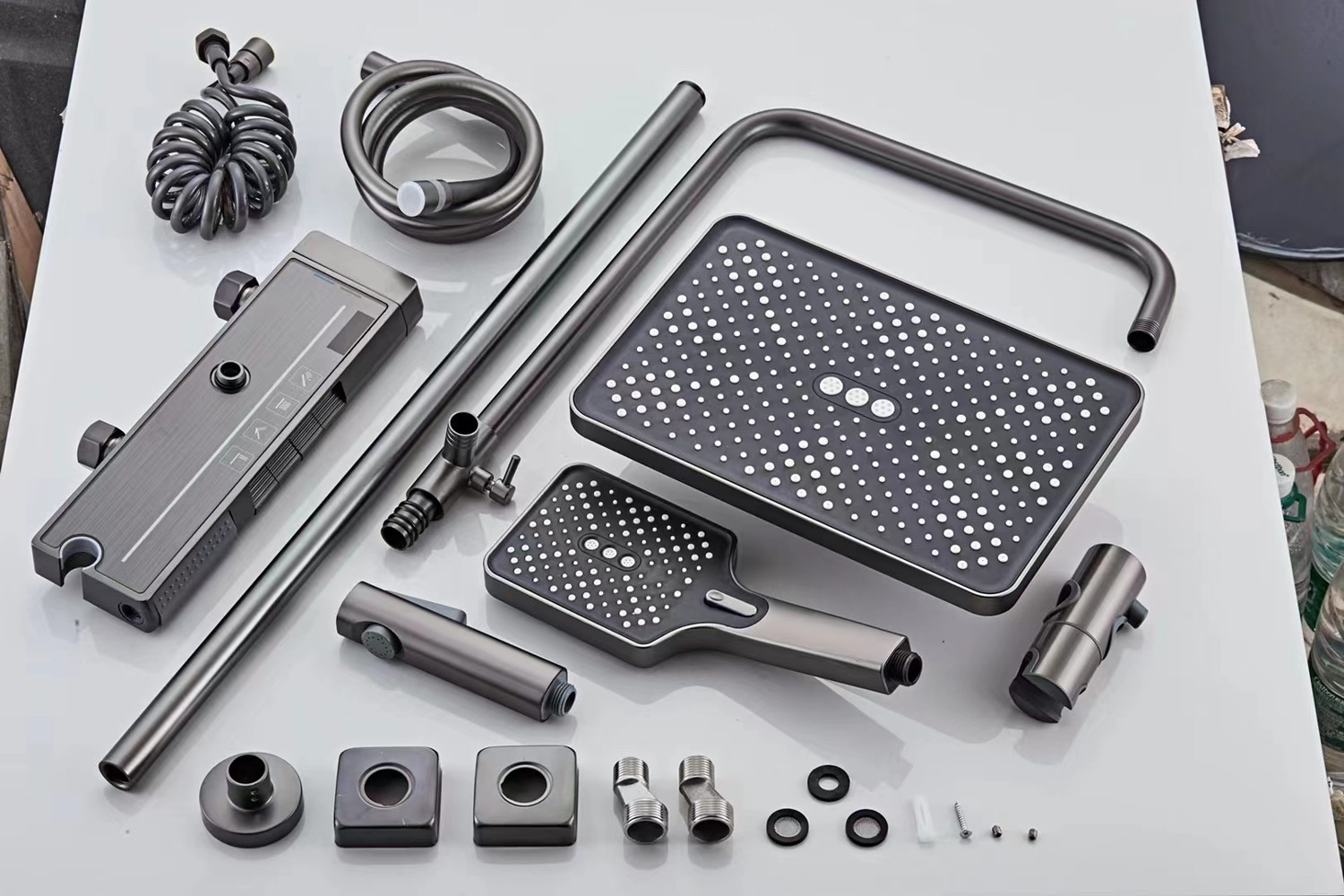
Shower sets are usually quoted as a single price, which makes comparison almost meaningless: the same headline figure can describe a set with a solid brass valve body and a reinforced hose, or one with a thin die-cast body and a hose that fails inside two years. Breaking the set into components is the only way to see which one you are being offered.
An exposed set is not one product but a dozen: valve body, rain head, hand shower, hose, riser, brackets and the small fittings that fail first.
Valve body and cartridge. The most expensive and least visible part. It sets the service life of everything downstream and is the one component you cannot upgrade later without opening the wall.
Rain head and hand shower. Where the visible cost sits. Size and spray pattern drive price far more than material quality does.
Hose and riser. The most common failure point in service and the easiest place to hide a saving. A reinforced inner tube with a proper braided sleeve costs more and lasts several times longer.
Fittings and trims. Screws, gaskets, cover plates and wall brackets. Trivial on the invoice, decisive when one is missing during installation.
This is why an inexpensive set is rarely "a little cheaper everywhere". It is usually close to the same cost in the visible parts and substantially cheaper in exactly two places — the valve body and the hose — which are the two components that generate the service calls.
Ownership
Total Cost of Ownership: The Number the Invoice Does Not Show
The purchase price is one line in a five-line calculation. The other four are installation, running cost, maintenance, and the cost of the asset being out of service. In most African markets the last two dominate, because labour and downtime are priced locally while the product is priced in dollars.
Cost line
What drives it
How specification changes it
Purchase
Body material, coating, component count
The only line a quote usually shows
Installation
Exposed versus concealed, wall preparation, access
Concealed costs more up front and less in visible labour later
Running
Flow rate of aerators and shower heads
A 2.0 gpm aerator against a 2.2 gpm baseline saves roughly 2,300 gallons (about 9 cubic metres) a year for a four-person household showering eight minutes a day
Maintenance
Cartridge, hose and seal life; local spare availability
Dominated by whether the part is in the country or on the next vessel
Downtime
Rooms or facilities out of use during repair
The line that makes cheap fittings expensive in hotels, hospitals and schools
Two consequences follow. In markets where a service call costs more than the tap, buying cheap and replacing often is the most expensive strategy available — not because the product is bad, but because labour is not free. And spare-part availability belongs in the specification, not in the after-sales conversation: a cartridge that arrives in three days and one that arrives in ten weeks carry different total costs at the same purchase price.
The question that reframes the whole decision
Ask what happens on the day it breaks, not what it costs on the day it is bought. If the answer involves waiting for a container, the cheap option was never cheap — the cost was simply deferred to a moment when you have no negotiating position.
Specification
Specifying by Building Type and Budget
The same product that is correct for a villa is usually wrong for a school, and the difference is not quality but duty cycle. Matching the specification to how the building is actually used is where most of the value in a selection decision sits.
Building type
Typical tier
Protect above all
Safe to economise on
Family homes
Mid
Valve body, hose, cartridge support
Rain head size, decorative trims
Apartments
Entry to mid
One standardised model across all units, so maintenance is predictable
Very little — but avoid over-specifying service areas
Schools
Entry
Vandal resistance, single spares pool, easy repair
Appearance, spray modes, head size
Hospitals
Mid
Anti-scald control, cleanability, no dead legs
Decorative finish, designer geometry
Shopping malls
Mid
High-cycle durability, standard spares, fast swap-out
Custom colours, bespoke shapes
Two patterns recur. Public and institutional buildings reward standardisation over refinement, because one spares pool across fifty fittings is worth more than any individual upgrade. Residential projects reward consistency, because a buyer experiences the bathroom as one room — a mismatched finish is more noticeable than a slightly lower grade of coating.
OYAQUA
How OYAQUA Handles the Trade-off
OYAQUA builds its range around the same three-way decision rather than around a single price point. The line covers all four body materials — SUS304, SUS201, brass and zinc alloy — and assigns them by function: brass where the valve body and concealed pipework have to last, stainless where an exposed body faces humidity, zinc alloy for light-duty parts. Which material appears in a given series depends on what that series is for, not on a single house rule. Surfaces are coated for the coloured and dark finishes, with traditional plating kept where it is the right answer; valves use ceramic cartridges; and is available in both exposed and concealed versions, so the installation decision can follow the building.
The part that matters most for total cost of ownership is not on the product at all. OYAQUA holds stock in seven African markets — Kenya, Tanzania, Uganda, Nigeria, Senegal, Zimbabwe and Guinea — with local sales teams, keeping fast-moving models and wearing parts close to the market. Where there is no local warehouse, orders ship from China stock with tracking end to end. Partners work under protected territories and margins with training and display support, which is what turns a first order into a repeat line.
Stock coverage shifts as lanes open and demand moves. Ask for the current list for your market before you build it into a specification.
FAQ
Frequently Asked Questions
Is it worth paying more for a brass body? If the fitting is concealed, thermostatic, or expected to stay in service for fifteen years or more, yes — brass is the material the application was designed around and it takes repair far better than a casting. If it is an exposed tap in a rental unit that will be refreshed in five years, a well-coated stainless body is a more sensible allocation of the same budget.
How long should bathroom fittings actually last? Published material bands run from five to ten years for zinc alloy, ten to fifteen for SUS201, fifteen to twenty for SUS304 and twenty to thirty for brass. In practice the coating, the water chemistry and the availability of spare cartridges move the real number more than the alloy class does.
Exposed or concealed for a renovation? Exposed, unless the walls are being opened anyway. Concealed is a better result and a worse retrofit: it needs a pre-set body, known pipe centres and an access strategy. Where the wall is already tiled and the plumbing is unknown, the exposed set is the decision that does not come back as a problem.
Key Takeaways
What to Take Away
Order the decisions correctly. Installation form first, then material and coating, then design. Reversing that order is how budgets get spent on the wrong layer.
Spend where change is expensive. Concealed valve bodies and wall preparation justify money; hoses, heads and trims do not.
Material sets the life, coating sets the look. Judge the alloy first and the finish second, and treat published service bands as ranges rather than promises.
Spare availability is a specification item. A part that is in the country changes the total cost of an identical product.