How to Choose Faucets for Hard-Water Areas in Africa
How-to & Guides · Faucet Selection
How to Choose Faucets for Hard-Water Areas in Africa
Most faucet complaints in hard-water regions are not product failures — they are specification failures. Test the water, then choose the body, the finish and the serviceable parts around what the test says.
Hardness decides three things: which body material survives the water, which finish you are allowed to clean aggressively, and how often the aerator needs descaling. Get those three right and a tap will look and run like new for years; get them wrong and no amount of aftercare will save it.
Start With a Number: Test the Water Before You Specify
Hardness is the concentration of dissolved calcium and magnesium, given as milligrams per litre of calcium carbonate (mg/L as CaCO₃). The U.S. Geological Survey classification is the one most widely quoted:
| Classification | Hardness as CaCO₃ | What it means for a faucet |
|---|---|---|
| Soft | 0–60 mg/L | Scale is not a practical concern |
| Moderately hard | 61–120 mg/L | Spotting if taps are left wet; descale aerators a few times a year |
| Hard | 121–180 mg/L | Scheduled descaling; finish choice starts to matter |
| Very hard | Above 180 mg/L | A maintenance plan, and pre-treatment is worth costing |
Hardness is an operational parameter, not a health one. The World Health Organization sets no health-based limit for it. The problem is what the minerals leave behind.
What the African data actually shows
Published groundwater surveys make one point clearly: there is no continental average, so a specification copied from one market to the next will eventually be wrong.
- Ghana, Ga East Municipality — three boreholes at 66.0, 91.3 and 73.7 mg/L, all moderately hard, with pH between 5.1 and 5.3. That water was acidic and aggressive rather than scale-forming.
- Ghana, Upper West and Northern regions — total hardness from 22 to 337.5 mg/L across the sampled boreholes, spanning soft to very hard inside one study area.
- Nigeria, Onicha-Uburu (south-east) — 16 to 140 mg/L, soft through moderately hard.
Note the second half of the first result. Low pH attacks metal while high hardness deposits on it, and the two demand opposite responses. Acidic water is a corrosion problem to raise with your supplier; hard water is a maintenance problem you plan for. Both start with the same test.
What Hard Water Does Inside a Faucet — and the Parts That Fail First
Hard water carries dissolved calcium and magnesium bicarbonate. When water is heated or left to evaporate, those bicarbonates lose carbon dioxide and precipitate as solid calcium carbonate — the white crust on a spout, and the same material that narrows a pipe from the inside.
Two consequences follow. Scale forms as the last drops evaporate, not while water is running, which is why wiping a tap dry after the final use of the day achieves more than any polish applied later. And the hot side scales faster than the cold side, because heat drives the reaction.
- The aerator. The mesh at the spout tip is the finest restriction in the water path, so it catches precipitate first. A blocked aerator accounts for most "my tap has lost pressure" complaints, and it is a ten-minute fix.
- The cartridge. Scale on the ceramic disc faces shows up as a stiffening handle or a mixer that drips when closed. Less common than aerator blockage, far more expensive to ignore.
- The spray head. On a pull-out faucet each spray mode uses different channel geometry, so scaling first appears as one mode that sprays at an angle or loses its pattern.
- The visible surface. White spotting around the spout base and deck plate. Cosmetic, but it is what a hotel guest notices and what generates the complaint call.
Ask how reachable those parts are
Two taps with identical bodies can have very different service lives, and the difference is access. Compare them on three questions: does the aerator unscrew by hand, is the cartridge a stocked spare rather than a factory order, and how many channels does the spray head have to keep clear. A tap that is easy to service will outlast a better-specified tap that is not.
An aerator also smooths the stream and cuts consumption — an un-aerated spout can run above 8 litres per minute, where an aerated one typically delivers 5 to 7 with a fuller-feeling flow.
Symptoms to read as scale rather than pressure: flow dropping well below the rated output, a stream that splits into two or more patterns, water leaving the spout at an angle, a whistle at full opening, or white crust at the tip. If only one tap in a building is affected, it is almost always the aerator.
Body Materials: SUS304, SUS201, Brass and Zinc Alloy
OYAQUA faucets and shower sets are built on four body materials — SUS304 stainless steel, SUS201 stainless steel, brass and zinc alloy. The twelve best-selling faucet models used as the worked example in this guide draw on two of them, ten on SUS201 and two on zinc alloy, but the other two are very much part of the range: brass waterways and valve bodies carry the concealed and thermostatic shower sets, and 304 is specified where the application calls for it. When you are matching a fitting to a water analysis, all four belong on the table.
| Body material | Where it appears in the range | Strength in hard water | The honest limit |
|---|---|---|---|
| SUS304 stainless steel | Specified across the shower and faucet ranges where the application calls for it | Roughly 18–20% chromium and 8–10.5% nickel gives the most robust passive film of the stainless grades. The safe answer for coastal, humid and high-specification projects | Higher material cost, and it is not immune — sustained chloride exposure can still pit it, so coastal projects need the wipe-down routine regardless |
| SUS201 stainless steel | Ten of the twelve best-selling faucet models, including all four KT cold taps, both KM brushed models, and the BM-302C and BM-309H basin mixers | Light, rigid and stable in dry or intermittently wet conditions; the workhorse for volume projects | Lower nickel and higher manganese than 304 means the passive film is less robust. In chloride-bearing or persistently acidic water it is markedly more prone to pitting, particularly at edges and machining marks |
| Brass | Waterways and valve bodies across the concealed and thermostatic shower sets, and in faucet bodies | The strongest of the four for hard water specifically, for a reason that surprises most buyers — high carbonate hardness tends to protect brass rather than attack it. Machines cleanly, holds pressure, and has the longest service record | Dezincification in soft, low-alkalinity, chloride-rich or high-pH water, accelerated above roughly 60 °C and in stagnant runs. Ask for a dezincification-resistant alloy by name in those conditions |
| Zinc alloy | BM-315C and BM-316H basin mixers | Takes a very smooth plated finish and holds complex shapes at a lower body cost | Relies entirely on the plating as its barrier. If the coating is scratched through, the substrate underneath has little corrosion resistance of its own |
Type 201 stainless carries roughly 16–18% chromium and 3.5–5.5% nickel with manganese substituted for part of the nickel; type 304 carries 18–20% chromium and 8–10.5% nickel. Nickel stabilises the passive film that makes stainless stainless, so a lower-nickel grade reforms it more slowly after damage. Published laboratory comparisons put the gap in plain terms: under neutral salt-spray testing at 35 °C with 5% sodium chloride, brushed 304 showed no red rust at 96 hours while brushed 201 had passed 20% corroded area by 72 hours and was judged failed by 96. In a 5% acetic acid soak over 72 hours, 304 was unchanged while 201 developed a dull film and localised pitting.
Brass behaves the other way round, and this is the part worth remembering. Scale is a nuisance on the surface of a fitting, but a thin carbonate layer inside a brass body acts as a barrier — so hard water is closer to a preservative than a threat for brass. What damages it is the opposite chemistry: soft water with little alkalinity, high chloride, pH above about 8, and hot water sitting still in a dead leg. There, zinc is selectively leached out of the alloy and what remains is a porous copper shell that looks intact and then fails under pressure. The two conditions do not overlap much in practice, which is why brass and stainless are not rivals here — they cover different water.
What that means on site:
- Inland, intermittently wet, low-chloride conditions — a SUS201 body is a sound, cost-appropriate choice, and the majority of OYAQUA installations sit here.
- Coastal and salt-laden air — Lagos, Tema, Abidjan, Dakar, Durban, Mombasa. Chlorides are the weakness of both stainless grades. Step up to 304 where the budget allows, specify a plated finish rather than bare brushed metal, and keep the descaling cycle short.
- Acidic groundwater — several West African borehole studies record pH below 6. Low pH attacks the passive film on steel and accelerates dezincification in brass. Raise it before ordering, not after installing.
- Hot water above about 60 °C, or long stagnant runs — the condition that matters for brass rather than steel. Ask for a dezincification-resistant alloy, and avoid dead legs where water sits against the body.
If your project sits on the coast, runs hot water above 60 °C, or you already know the borehole is acidic or unusually soft, tell us before you order — send the water data with your enquiry and we will confirm which of the four body materials and which finish suits that water.
Finish: Pick a Surface You Can Actually Clean
This is the decision that most affects how a faucet looks after two years, because a hard-water region is also a region where you will be descaling regularly. The finish you choose determines which descaling agents you are allowed to use. Get it wrong and the cure damages the product.
The rule is straightforward: chrome and plain stainless tolerate full-strength vinegar or citric acid for 30 to 60 minutes. Gun grey, brushed and matte black finishes are acid-sensitive — the protective layer is thin and prolonged contact with even mild acid etches it permanently. Strong commercial descalers built for unfinished surfaces will strip a matte black or coloured finish outright.
| OYAQUA finish | How scale shows on it | Safe descaling | Never use |
|---|---|---|---|
| Polished chrome (suffix C) | Spots are visible but wipe off easily; the most forgiving surface for hard water | White vinegar or citric acid, full strength, 30–60 minutes | Abrasive pads and steel wool — permanent fine scratches |
| Gun grey (suffix H) | Hides spotting better than chrome, which suits busy kitchens | Vinegar diluted 1:1, 10–15 minutes, then rinse and dry | Descalers containing hydrochloric or phosphoric acid |
| Brushed stainless (suffix N) | Shows water spots readily; no coating above the substrate | Citric acid or diluted vinegar, short contact, dry thoroughly | Anything abrasive — the brushing direction cannot be repaired |
| Matte black (suffix K) | Spots are highly visible against the dark surface | Soapy water or a baking-soda paste; if acid is needed, dilute heavily and limit contact to a few minutes | Vinegar left on over 30 minutes; undiluted descalers; bleach |
The finish suffix is the last character of every OYAQUA model code — C chrome, H gun grey, N brushed, K matte black. The code on the box tells you the cleaning rules.
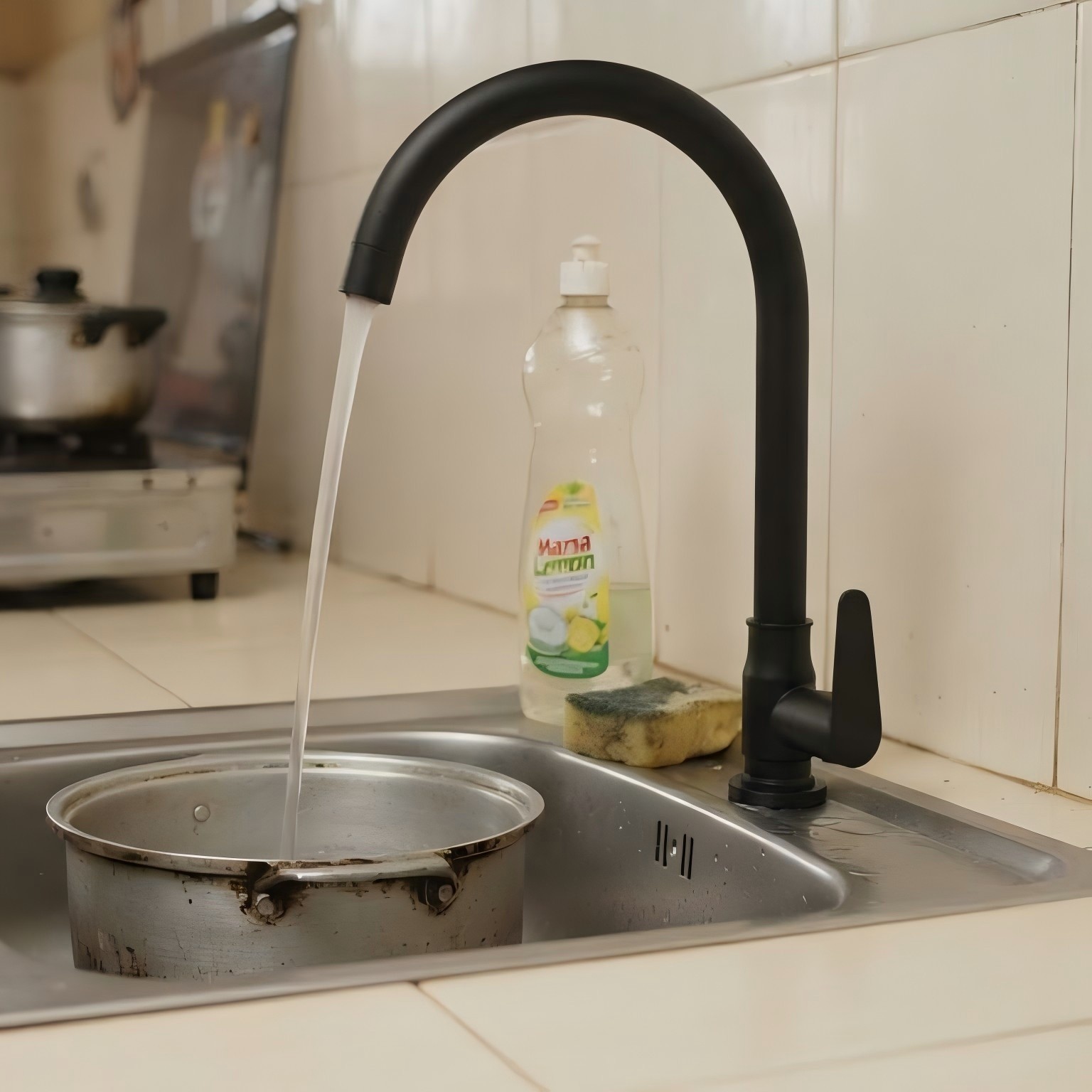
How to Descale an Aerator Without Damaging the Finish
This is the routine to hand over with every installation in a hard-water area. About ten minutes, and it prevents the majority of service calls.
- 01Unscrew the aerator by hand. Wrap a cloth around it so no tool touches the finish. If it will not move, tie a small bag of white vinegar around the spout so the aerator sits submerged, leave it one to two hours, then try again.
- 02Separate the parts and note the order. Housing, mesh screen and flow restrictor come apart. Lay them out in sequence so reassembly is obvious.
- 03Soak. Chrome and plain stainless: white vinegar for 30 to 60 minutes, or a citric acid solution — roughly two tablespoons of powder in 500 ml of warm water — for 15 to 30 minutes. Gun grey, brushed and matte black: dilute the vinegar one-to-one and keep contact to 10 to 15 minutes.
- 04Brush, rinse, reassemble. An old toothbrush on the mesh, rinse under running water, screw the aerator back on hand-tight. Warming the solution to around 40–50 °C noticeably speeds the reaction.
- 05Put the next one in the diary. Frequency follows hardness: every six to eight weeks above roughly 170 mg/L, every three months between about 70 and 170, every six months below 70.
| Hardness as CaCO₃ | Descaling interval | Daily habit |
|---|---|---|
| Below 70 mg/L | Every 6 months | Occasional wipe-down |
| 70–170 mg/L | Every 3 months | Wipe dry after last use |
| Above 170 mg/L | Every 6–8 weeks | Wipe dry after every evening use |
| Above 300 mg/L | Monthly, and cost a pre-treatment option | Wipe dry, and check the hot side first |
Five things that cause permanent damage
Scouring pads, steel wool and abrasive brushes, which scratch chrome permanently. Undiluted descaler left on a matte black, brushed or coloured finish — the damage comes from dwell time, so set a timer. Bleach, which corrodes metal and must never be mixed with vinegar. Hydrochloric or phosphoric acid cleaners on anything other than plain chrome. And leaving acid on a fitting overnight, which damages internal seals as well as the surface.
Shortlist by Water Condition
Pulling the three decisions together, here is how the OYAQUA range maps onto real conditions. The water test comes first; this is the starting shortlist, not a fixed rule.
| Water condition | What to prioritise | Shortlist from the range |
|---|---|---|
| Soft to moderately hard inland (below 120 mg/L) | Open choice; pick on design and budget | Any model. KT-2401N and KT-2404N brushed cold taps are the volume workhorses |
| Hard, with scheduled maintenance (120–180 mg/L) | Chrome or gun grey; removable aerator | BM-302C, BM-309H, KM-603N, KM-616H |
| Very hard, above 180 mg/L | Plated finish, monthly descaling, spares held | BM-302C and BM-309H for basins; KM-616H where a pull-out head is required, with the head in the routine |
| Coastal salt air, or acidic groundwater below pH 6 | Plated finish over brushed; confirm before ordering | BM-302C, BM-316H, KM-616H. Confirm the body and finish on the water data — see R&D and Design |
Where descaling will be frequent, hold spares with the order. Aerators, cartridges and complete replacements for this range are stocked in OYAQUA's overseas warehouses across seven African markets — Uganda, Zimbabwe, Nigeria, Senegal, Guinea, Kenya and Tanzania — so they can be turned around locally rather than shipped from the factory. Full model detail is listed under Faucets & Taps.
When Descaling Is Not Enough
Above roughly 300 mg/L, or anywhere the maintenance interval has slipped below monthly, treat the water rather than the tap. Three options sit in ascending order of cost and commitment.
Sediment pre-filtration. The cheapest and most universally useful step. A cartridge filter at the incoming main captures the sand, rust and suspended solids that borehole and tank-stored water carries. It does not remove hardness, but it stops the grit that scores cartridge faces and blocks aerator mesh between descales.
Scale inhibitor dosing. Polyphosphate or similar food-grade dosing keeps calcium and magnesium in solution rather than removing them, so the water stays hard but does not deposit. A low-cost retrofit at the point of entry, and often the right answer for a single building that cannot justify a softener.
Ion-exchange softening. The complete answer, and the most expensive. It replaces the hardness ions with sodium, which is worth noting for a kitchen tap used for drinking and cooking — the usual practice is to leave one cold kitchen line unsoftened. Softened water is also more aggressive to metal than hard water, so if you soften, confirm the faucet specification again rather than assuming the problem is gone.
A faucet is the last component in the chain. It should not be asked to solve a water problem on its own.
Frequently Asked Questions
How do I know whether my water is hard enough to worry about?
Test it. Below about 60 mg/L as CaCO₃ is soft and nothing special is required. Between 60 and 120 you should wipe taps dry and descale aerators a few times a year. Above 180, build maintenance into the handover and start costing pre-treatment.
Is hard water in Africa generally worse than elsewhere?
No — and that assumption causes bad specifications. Published borehole surveys record 22 to 337.5 mg/L within a single Ghanaian study region and 16 to 140 mg/L in south-eastern Nigeria. Some sources are soft; others, especially carbonate aquifers, are genuinely very hard. Test per project.
Which finish should I pick if I know descaling will be frequent?
Polished chrome. It is the most tolerant surface for both vinegar and citric acid and releases scale most easily. Gun grey hides spotting better between cleans but wants diluted acid and short contact. Matte black is the most striking and the least tolerant — it needs a drying habit rather than frequent acid.
My kitchen tap sprays sideways. Is it broken?
Almost certainly not. That is the classic symptom of a scaled aerator or spray head. Remove it, soak it in vinegar or citric acid solution, brush the mesh and refit. Check the hot side first, because heat accelerates deposition.
Which body materials does OYAQUA offer — is it only 201?
No. The faucet and shower ranges are built on four: SUS304, SUS201, brass and zinc alloy. The twelve best-selling faucet models used as examples here draw on SUS201 and zinc alloy, while brass waterways and valve bodies carry the concealed and thermostatic shower sets and 304 is specified where the application calls for it. Tell us the water analysis and we will point you at the right one.
Related Reading
Key Takeaways
Test, then specify — and choose the finish you can actually clean.
- Get one number before ordering: total hardness as mg/L CaCO₃, plus pH. Published African borehole data spans 22 to 337.5 mg/L within one study region, so there is no safe continental assumption.
- Scale forms on evaporation, not on standing water — wiping a tap dry after the last use of the day is the single most effective habit, and it is safe on every finish.
- The aerator fails first and accounts for most "lost pressure" complaints. Every OYAQUA model uses a removable mesh aerator, so the fix is a soak rather than a replacement.
- Match the finish to the cleaning it will need. Chrome tolerates full-strength vinegar and citric acid; gun grey, brushed and matte black want diluted acid and short contact; strong commercial descalers damage all three.
- Match the body material to the water, not to the habit. SUS201 is right for inland and intermittently wet use; step up to SUS304 for coastal and high-specification projects; brass is the strongest choice in genuinely hard water because carbonate hardness protects it, but ask for a dezincification-resistant alloy where the water is soft, high in chloride or runs hot.