How to Choose the Right Shower System for Your Bathroom
Oct 19,2026
Selection Guide
Most shower systems are chosen in the wrong order. Buyers start with the photograph, then the price, and discover on site that the wall cannot take a concealed valve, the roof tank cannot feed a 300 mm rain head, or the hot water cylinder cannot hold a steady temperature at 7 a.m. This guide reverses that order: water first, then the wall, then the valve, then the outlets, then the finish.
Figures below come from published standards, manufacturer installation instructions or industry reference ranges, and are labelled as such. Where a number depends on your site, it is presented as something to measure rather than something to assume.
Start With Water Pressure, Not the Display
Before comparing finishes, measure two things: the dynamic pressure at the shower outlet, taken with a tap running elsewhere, and the source of hot water. Those two numbers eliminate half the catalogue before you fall for a system that cannot work in your building.
Where water comes from a rooftop tank or a gravity-fed solar cylinder, pressure is set by height, not by the pipe. The working conversion is roughly 0.1 bar per metre of head from the water surface to the outlet, before friction losses: 3 m gives about 0.29 bar, 5 m about 0.49 bar, 10 m about 0.98 bar. Industry guidance puts a basic shower head at 3 to 5 m of head, while thermostatic mixers sit at the margin below roughly 10 m. Mains supply commonly runs between 1 and 5 bar, and a low-pressure solar cylinder is typically rated under 0.5 bar.
A large face spreads the same flow over more area, which is why a rain head that looks generous in a showroom arrives as a trickle on the top floor of a gravity-fed house. For three or more outlets, trade guidance suggests budgeting roughly 6 to 8 gallons per minute, about 23 to 30 litres, for the whole system. That is a supply question, not a trim question.
Supply condition
What it supports
What to avoid
Gravity tank, under 0.5 bar
Single fixed head or exposed set with a simple mixer
Large rain heads, body jets, most thermostatic cartridges
An undersized supply pipe feeding the whole bathroom
If the answer is a booster pump, size it for the bathroom group, not for one shower. A pump that lifts pressure to 5 bar where 2 bar is needed shortens washer life and makes water hammer audible through the house.
Exposed or Concealed: The Decision You Cannot Undo
This is the only choice on the list that is genuinely hard to reverse. An exposed system carries the valve body on the wall: it fits a finished bathroom, can be replaced without breaking tiles and is always inspectable. A concealed system buries the body in the wall and leaves a plate and handle visible: cleaner in a small room, easier to wipe down, dependent on a cavity that will accept a rough-in box.
The test is access, not taste. If the wall is tiled and you are not opening it, exposed is the honest answer. If you are building or stripping the room anyway, concealed earns its extra plumbing because the wall is open once. Confirm four things before ordering: usable depth inside the wall, the position of any stud or column, whether the pipe run clears a doorway, and whether the cartridge can be serviced from the front without removing tiles.
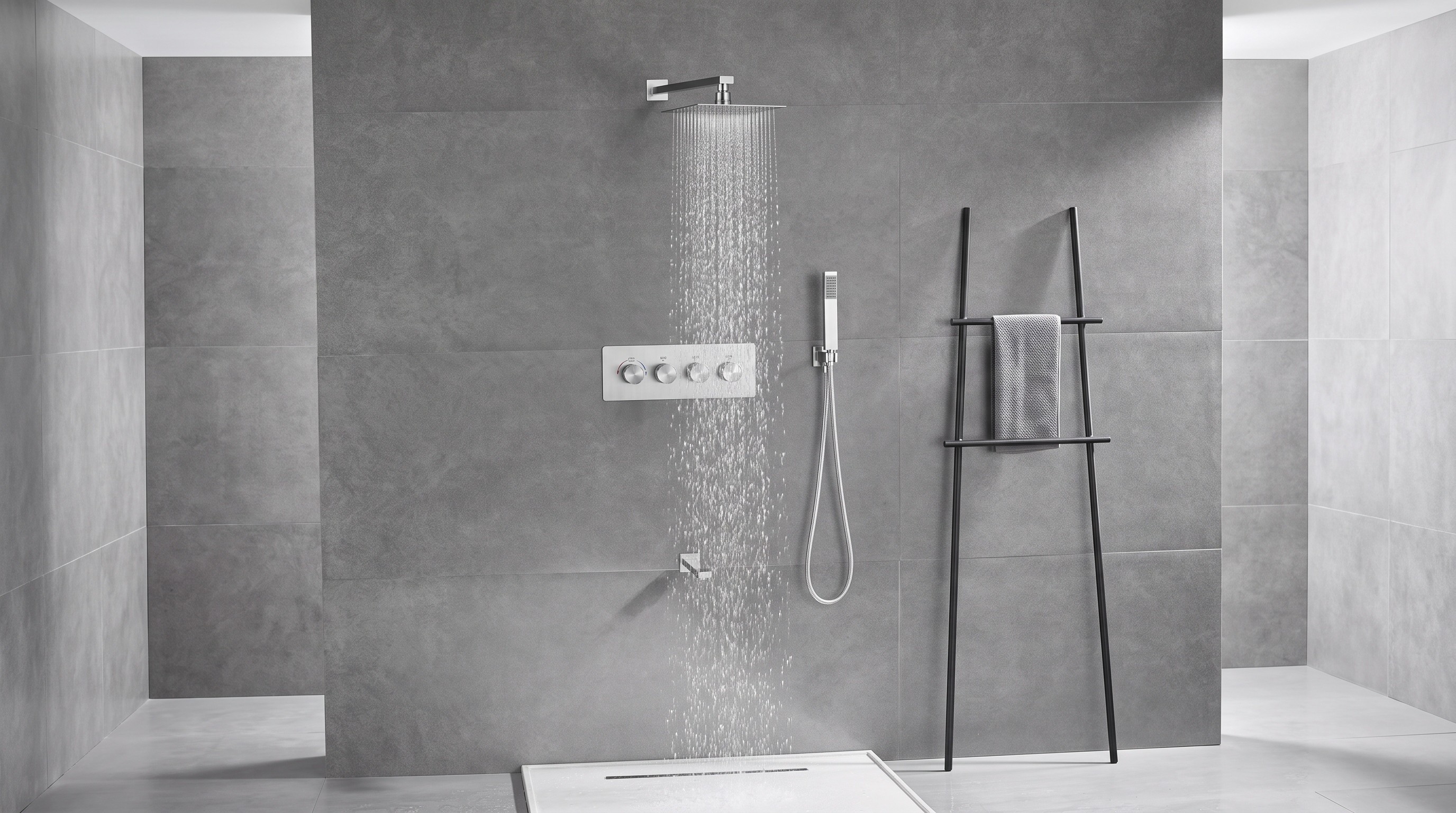
A concealed set keeps the wall plane intact: the valve body sits behind the plate, and only the head, control and spout are visible. Photo: OYAQUA product photography.
Point
Exposed
Concealed
Fitting to a finished bathroom
Straightforward
Requires opening the wall
Cartridge service
At the surface
Front access through the plate, if the body allows it
Wall depth needed
None beyond the riser
Rough-in box plus pipe clearance
Best moment to choose
Occupied renovation, rental stock
New build, full refurbishment, hotel and apartment programmes
One sourcing trap deserves its own line: some listings sell the trim only, with the rough-in body in a separate box. On a project, that is discovered after the wall is closed. Check that valve body, cartridge and fixings are all in the carton before the tiler starts.
The Valve Decides Comfort and Safety
Three valve families cover almost every bathroom. A manual mixer blends hot and cold as you turn it: cheapest, simplest, entirely dependent on the user. A pressure-balance valve holds the hot-to-cold ratio so a toilet flush does not scald you, but it protects by cutting flow, which is why the shower weakens rather than holds steady. A thermostatic valve holds the outlet temperature itself, typically within about 1 to 2 degrees Fahrenheit in published specifications, and adds a stop limit so the handle cannot be pushed into a dangerous range.
For a family bathroom with children or elderly users, and for any system running two or more outlets, thermostatic is the right platform. Published installation guidance commonly sets the anti-scald stop near 49 degrees Celsius, with local codes sometimes lower. But the cartridge needs a pressure difference to work against: on a gravity system with a very low head it may respond slowly or not at all. That is why pressure comes first.
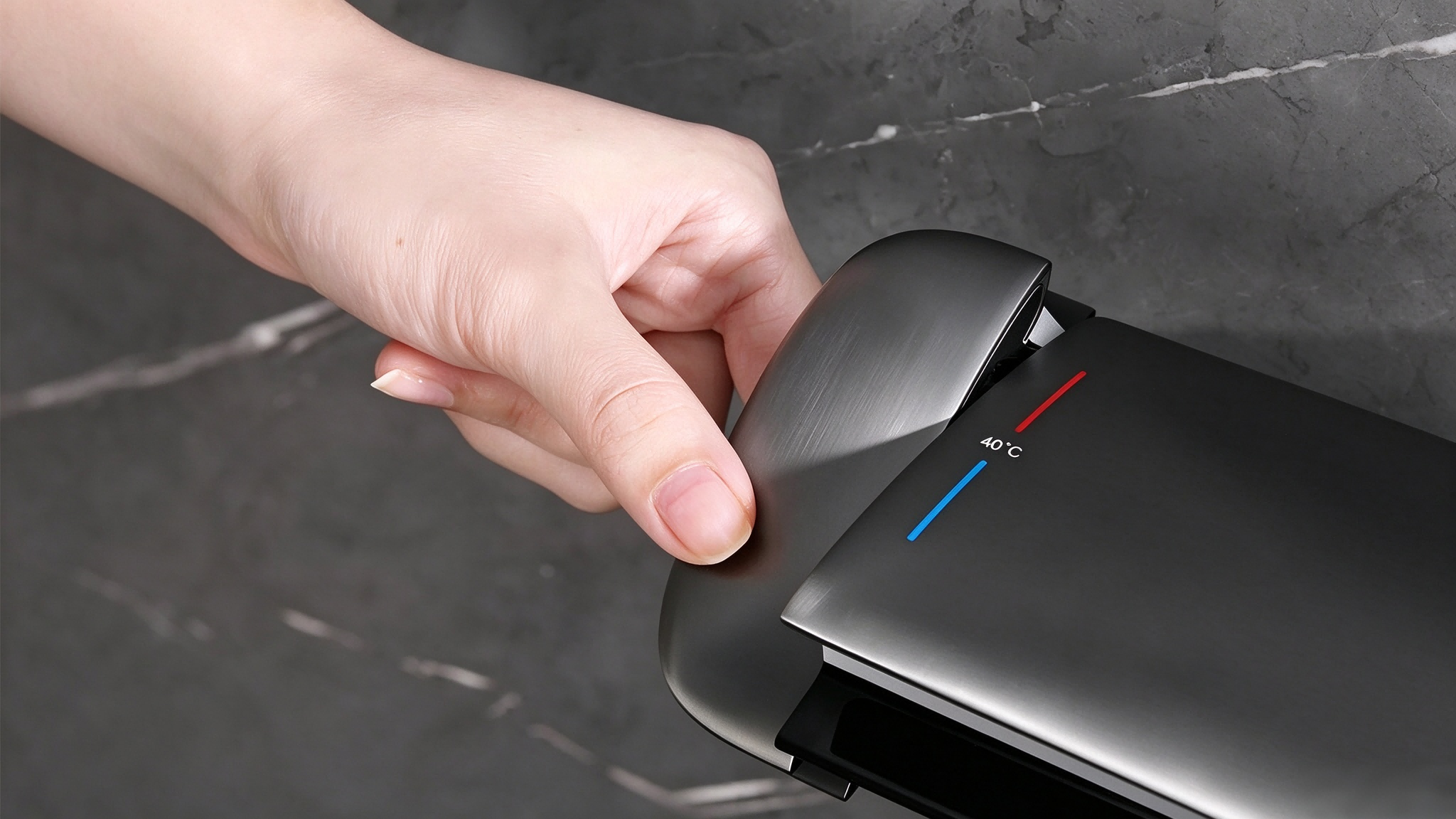
A thermostatic control with a marked 40 degree reference and push-button outlet selection. The stop behind the dial is what prevents the handle being turned past a safe limit. Photo: OYAQUA product photography.
Two maintenance facts are worth knowing. Thermostatic elements drift over time, so recheck the stop limit seasonally when incoming water temperature changes. And a valve set to 40 degrees does not guarantee 40 degrees at the head: pipe runs, dead legs and an undersized hot supply all move the number.
Choose Outlets by Routine, Not by the Number in the Title
Outlet count is the least useful specification in the catalogue. What matters is which outlet does which job in your household. An overhead rain head gives wide, soft coverage and is the reason people buy a rain shower, but it is poor at rinsing shampoo from a child or washing the shower down after use. A hand shower does both, and is the outlet that actually gets used in most homes. A bath spout fills a tub or a bucket without soaking the room. Body jets are a pressure-hungry luxury that only make sense once the supply has been proven.
Selection therefore comes down to combinations rather than totals. Overhead plus hand shower covers daily use in a compact bathroom; overhead, hand shower and bath spout suits a tub-and-shower room; adding body jets changes the valve specification and the supply requirement, not just the trim. On the control side, push-button selectors are easier to operate with wet hands and make the active outlet obvious, while a rotary diverter gives finer control but is less clear in use.
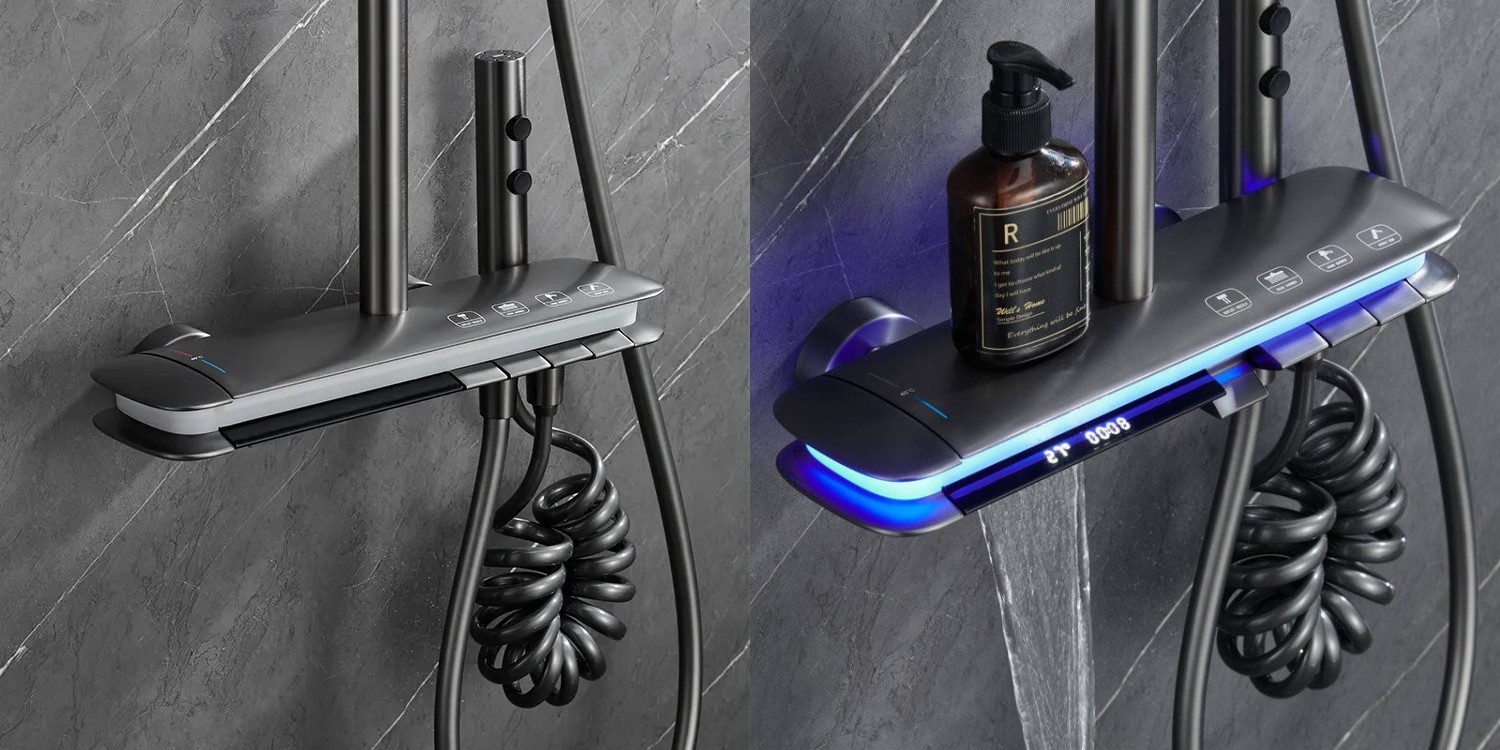
An exposed set with push-button outlet selection: each key maps to one outlet, which removes the guesswork of a rotary diverter when hands are wet. Photo: OYAQUA product photography.
Outlet
What it is good at
What it demands
Overhead or rain head
Wide coverage, low-effort daily shower
Higher flow; a large face amplifies weak pressure
Hand shower
Rinsing, washing the shower down, children and pets
Hose length and a holder at usable height
Bath spout
Filling a tub or a bucket
Correct height above the rim and a safe air gap
Body jets
Targeted spray in a larger shower
Roughly 45 psi plus a thermostatic valve with independent volume control
Heights and Set-Outs to Fix Before Tiling
Most complaints about a new shower trace back to a dimension decided by eye. Published installation instructions from major valve makers are a useful benchmark even if you buy elsewhere: valve centre around 1143 to 1219 mm above the shower floor for a shower-only installation, about 813 mm above the tub floor where a spout is involved, and the shower arm at roughly 1981 mm. Overhead heads are commonly set between 2000 and 2200 mm above finished floor, adjusted to the tallest regular user plus a margin.
Two dimensions cause most rework. The first is the gap between valve and bath spout: too little and water runs from the head while the tub fills, so published guidance puts the spout roughly 150 to 280 mm below the valve. The second is the hot and cold centre distance, commonly 150 mm in European and Asian pipework, which must match the valve body rather than be adapted on site with flexible connectors.
Dimension
Common value
Why it matters
Valve centre, shower only
1143 to 1219 mm above floor
Reach and safe operation for adults and children
Valve centre, over a bath
About 813 mm above tub floor
Keeps the spout relationship workable
Shower arm and overhead head
Arm about 1981 mm, head 2000 to 2200 mm
Coverage without flooding the door line
Hot and cold centres
150 mm typical
Must match the rough-in body exactly
Bath spout below valve
150 to 280 mm
Prevents the head running while the tub fills
Mark these on the wall before the first tile goes up, photograph the marked wall, and keep the rough-in drawing with the project file. On a multi-unit job, that photograph is the fastest proof that an installer deviated from the drawing.
Material and Finish: What Year Five Looks Like
Shower bodies in this category come from four material families: SUS304 stainless steel, SUS201 stainless steel, zinc alloy and brass. Which one a model uses depends on the part and the price point, so a material list on one data sheet should never be read as the whole range. As a rule, brass is used where pressure and temperature control matter most, such as concealed and thermostatic valve bodies and waterways; 304 appears where corrosion resistance is the priority; 201 covers cost-sensitive exposed parts; zinc alloy sits at the entry level and is better kept away from pressurised bodies.
The difference between 304 and 201 is measurable. 304 carries roughly 18 to 20 percent chromium and 8 to 10.5 percent nickel; 201 carries about 16 to 18 percent chromium and 3.5 to 5.5 percent nickel. In neutral salt spray testing at 35 degrees Celsius with 5 percent sodium chloride, published results put 304 at 96 hours without red rust, while 201 shows more than 20 percent corrosion area by 72 hours and is judged failed at 96 hours. In humid or poorly ventilated bathrooms, that gap is the difference between a finish that survives and one that does not.
Finish matters as much as the substrate, and PVD coatings resist scratching and tarnish better than conventional electroplating where a fitting is cleaned daily. Whatever the substrate, the finish is only as good as the cleaning regime: a neutral cloth and water, no abrasive pad, no acidic cleaner left to dry on the surface.
Material
Typical use
Reference service band
Brass
Concealed and thermostatic valve bodies, waterways
20 to 30 years
SUS304
Exposed bodies, humid interiors and high-use bathrooms
15 to 20 years
SUS201
Cost-controlled exposed parts, inland interiors
10 to 15 years
Zinc alloy
Entry-level trim and non-pressurised parts
5 to 10 years
These bands are published industry reference ranges for the material families, not a warranty. Actual life depends on water chemistry, cleaning practice and frequency of use.
The Order Checklist
Run this list once, in writing, before the purchase order goes out. It takes about twenty minutes and prevents most of the site problems described above.
Dynamic pressure measured at the outlet, with another tap running
Hot water source, cylinder capacity and rated pressure recorded
Wall type, cavity depth and structural obstacles confirmed on site
Exposed or concealed decision fixed before tiling
Valve family chosen for the users, not for the price tag
Outlet combination matched to daily routines
Valve height, spout height and hot-cold centres marked on the wall
Material and finish matched to how often the shower will be cleaned
One spare cartridge and one spare hose held for the building
How OYAQUA Approaches the Same Checklist
OYAQUA builds its own range rather than producing to other brands' drawings, and organises it around the decisions above: exposed and concealed configurations within the same design language, push-button control on the piano-key sets, thermostatic options where the supply supports them, and four body material families so a specification can be matched to inland interiors or high-use hotel bathrooms. Finishes are PVD, which is the practical choice where a fitting is cleaned daily.
For buyers working in Africa, logistics matter as much as specification. Stock is held in seven markets, Kenya, Tanzania, Uganda, Nigeria, Senegal, Zimbabwe and Guinea, each with a local sales team; markets without a warehouse ship from China stock with a single contact and a confirmed packing date. Distributors get starter packs, display support, training and protected margins within an agreed territory.
Do I need a thermostatic valve with only one shower outlet? Not strictly. A pressure-balance valve meets the anti-scald requirement for a single outlet and costs less. Thermostatic control earns its price with children or elderly users, with several outlets running together, or where the hot supply fluctuates.
Can I fit a rain head on a gravity-fed system? Only if the head is small enough for the available flow. A large face spreads the same litres over more area, so the shower feels weak. Measure the head height first, then choose a diameter the supply can fill.
What should be kept in stock after installation? On a single home, one spare cartridge and one spare hose. On a building with several units, one cartridge per valve type plus two hoses: the parts that fail are the ones nobody can buy locally on a Sunday.
What is the most common specification mistake? Ordering the trim without confirming that the rough-in valve body is included and matches the pipe centres. It is discovered after the wall is closed, and costs more to fix than any finish upgrade.
The Short Version
Measure the pressure and identify the hot water source. Decide exposed or concealed while the wall is still open. Choose the valve for the people who will use the shower, then the outlets for what they actually do. Fix heights and centres before tiling, match the material and finish to how the room is used and cleaned, and hold a spare cartridge. Everything else, including the trim, is easier to change later.